
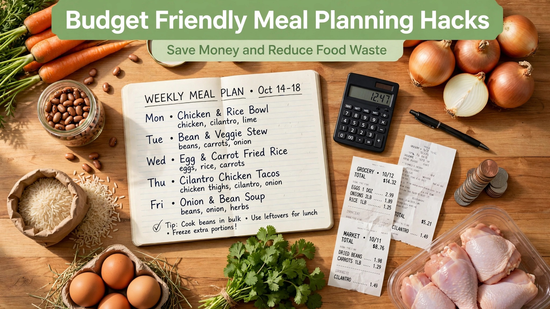
Budget Friendly Meal Planning Hacks: Save Money and Reduce Food Waste
Budget friendly meal planning hacks are simple: cook with what’s in your kitchen, stick to your list, and plan leftover nights so food doesn’t go bad. A family of four that drops from a moderate to a low-cost grocery budget this way keeps about $3,100 a year.
Key Takeaways
- Planning dinners from a fridge and pantry inventory first prevents duplicate purchases, a leading cause of spoiled food.
- Moving a family of four from a moderate grocery budget to a low-cost one frees up about $262 a month under current federal benchmarks.
- Planning five dinners instead of seven, with two leftover nights, cuts both cooking time and waste.
- Cooked leftovers stay safe for only a few days in the fridge, so the freezer is the backup for anything not eaten by midweek.
- Unit prices, not package prices, reveal the real bargain on a grocery shelf.
What Are Budget Friendly Meal Planning Hacks?
Budget friendly meal planning hacks are small, repeatable habits that decide what a household will eat before anyone shops, so grocery money goes only to food that actually gets eaten.
How Much Can a Family Save With Budget Friendly Meal Planning Hacks?
A family of four typically keeps $262 to $365 a month by planning its way down one or two grocery tiers. The savings come from buying less food that spoils, not from eating less.
Federal food plans price a healthy diet at four spending levels.
| Plan tier | Monthly cost, family of four (Sept. 2026) | Approx. weekly cost | Yearly difference vs. moderate | Source |
| Thrifty | $1,024 | $236 | Save $4,380 | USDA Food and Nutrition Service, Cost of Food Report, September 2026 |
| Low-cost | $1,127 | $260 | Save $3,144 | USDA Food and Nutrition Service, Cost of Food Report, September 2026 |
| Moderate | $1,389 | $321 | Baseline | USDA Food and Nutrition Service, Cost of Food Report, September 2026 |
| Liberal | $1,682 | $388 | Spend $3,516 more | USDA Food and Nutrition Service, Cost of Food Report, September 2026 |
Each tier assumes every meal and snack gets cooked at home for two adults and two children ages 6 to 11. Teenagers push your number up. Toddlers pull it down, and takeout sits outside the math entirely.
Picture a household spending at the moderate tier today. If planning trims its bill to the low-cost level, that family keeps $3,144 over 12 months, enough to seed a starter emergency fund; reaching the thrifty tier demands more scratch cooking and cheaper proteins such as eggs, dried beans, and chicken thighs.
Track one month of receipts before changing anything. The tips that pay off fastest depend on where your money leaks: extra store trips, takeout nights, or food that spoils before anyone eats it.
How Do You Build a Weekly Meal Plan That Costs Less?
Build the plan backward: start from what your kitchen already holds, then buy only what fills the gaps. That order stops the duplicate jar of salsa and the third bag of spinach.
- Take inventory first. Spend 10 minutes checking the fridge, then the freezer, then the pantry, and note anything expiring within five days.
- Choose two anchors. Pick two items from that note, such as half a rotisserie chicken or a bag of softening peppers, and build the first two dinners around them.
- Plan five dinners, not seven. Leave two nights for leftovers or a clean-out meal like fried rice, a frittata, or loaded quesadillas.
- Overlap ingredients on purpose. One bunch of cilantro covers Monday tacos and Wednesday rice bowls, while one bag of carrots feeds a soup, a slaw, and lunchbox sticks.
- Price the list before you leave. Write it by store section, estimate each line, and set a hard ceiling for the total.
- Prep one base on Sunday. A pot of rice, a sheet pan of roasted vegetables, or a batch of shredded chicken turns weeknight cooking into assembly.
Step 3 carries the most weight. Say your average home dinner costs $15 in ingredients: turning two planned dinners into leftover nights keeps $30 a week in your pocket, or $1,560 a year, and it rescues food that would otherwise die in the crisper drawer.
Which Kitchen Hacks Save Time and Money?
Cook once, eat three times. The kitchen hacks that save time and money all follow that rule, whether you double a chili recipe to freeze half or roast two trays of vegetables while the oven is already hot.
A labeled freezer bin, a whiteboard menu on the fridge door, and a 45-minute Sunday prep block need no special gear. Together they remove the 6 p.m. scramble that usually ends in a takeout order.
Which Grocery Shopping Hacks Save the Most Money?
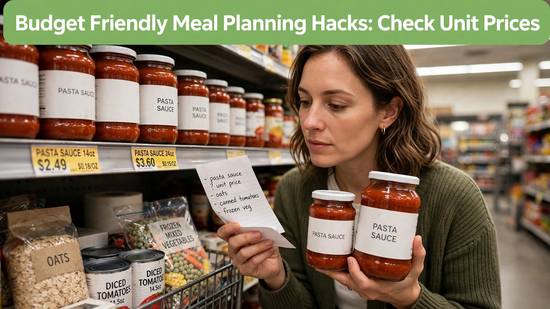
Compare unit prices, shop from a capped list, and visit the store once a week. Those three habits apply on every trip, so their savings compound.
The unit price on the shelf tag tells the truth that package size hides. A 24-ounce jar of pasta sauce at $4.29 works out to about 17.9 cents an ounce, while a 16-ounce jar at $3.19 runs 19.9 cents; the bigger jar wins, but only if your family finishes it within a week of opening.
Fewer trips matter just as much, since every quick stop for milk invites chips, cookies, and a candle nobody planned. Here are four more grocery shopping hacks to save money worth adopting:
- Build two dinners around the front-page sale items in the weekly circular.
- Choose store brands for staples like flour, canned tomatoes, oats, and frozen vegetables.
- Buy whole chickens or family packs only when you will portion and freeze them the same day.
- Check the markdown shelf for bread, meat, and produce near its sell-by date, then cook or freeze it that night.
How Should Families Organize the Fridge to Cut Waste?
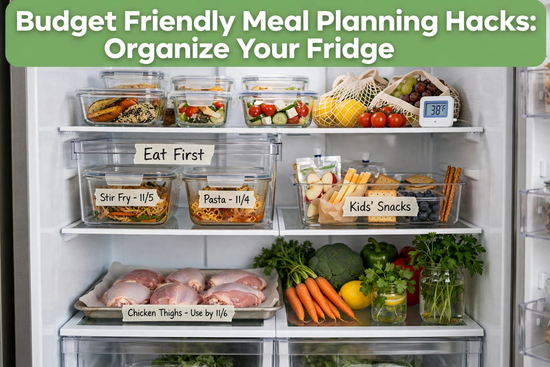
Arrange the fridge so the oldest food sits at eye level and the newest goes in back. People eat what they see.
USDA’s Food Safety and Inspection Service sets safe refrigerator temperatures at 40°F or below and caps most cooked leftovers at three to four days. Label every container with its cook date using masking tape and a marker, and on day three, either serve it or move it to the freezer.
These fridge organization hacks for families keep the system simple enough for kids to follow:
- An eat-first bin on the middle shelf for opened yogurt, half onions, and leftovers.
- A snack bin kids can grab from without digging through dinner ingredients.
- Keep ready-to-eat food up top and raw meat on a tray at the very bottom.
- Herbs standing upright in a jar of water, loosely covered with a bag.
An appliance thermometer on the top shelf costs a few dollars and catches a warm fridge before it spoils a week of groceries.
What Is the Biggest Meal Planning Mistake?
Planning seven ambitious dinners for a week that never goes as planned is the most common mistake. One late practice or surprise invite leaves ingredients for two meals rotting in the drawer.
People plan for their ideal week instead of their real one, and the cost adds up fast. ReFED’s 2026 U.S. Food Waste Report puts uneaten food at $762 per person each year.
Multiply that by four, and a family loses $3,048 a year, nearly three months of groceries on the thrifty budget. That waste figure measures money consumers actually lost, while the federal tiers describe recommended at-home budgets.
The fix is a smaller plan with a pre-decided backup. Of all the impocoolmom hacks we use in our own kitchen, the backup-meal rule is the easiest to start: keep one freezer meal and one pantry meal, such as pasta with canned tuna and lemon, ready for the night the plan collapses.
When Does This Advice Not Apply?
Singles and couples need a different rulebook, because most family-sized life hacks assume four people eating from the same groceries. For a one- or two-person household, the big bag of spinach with the better unit price often costs more per bite eaten, because half of it turns to slime before day five; pay the higher unit price for the smaller package, or split a family pack into freezer portions the day you buy it.
Frequently Asked Questions
How much should a family of four spend on groceries each month?
A family of four eating a nutritious at-home diet spends roughly $1,000 to $1,700 a month in late 2026, depending on the spending tier. Families with teenagers land near the top of that range, and frequent restaurant meals push totals past it.
What is the cheapest way to start meal planning?
The cheapest start is a free paper list built from a fridge and pantry inventory. Apps help with recipes, but the inventory habit delivers most of the savings and costs nothing.
How do you stop wasting fresh produce?
Buy delicate produce for the first four days of the week and rely on frozen or canned vegetables after that. Save hardy items like carrots, cabbage, and apples for late-week meals, and blend soft fruit into smoothies before it turns.
Is buying in bulk always cheaper?
No, bulk buying saves money only when your household finishes the food before it spoils. Rice, oats, and canned beans are safe bets; fresh produce and gallon tubs of yogurt are risky for small households.
How many meals should you plan each week?
Most households do best with five planned dinners and two flexible nights. Breakfasts and lunches can repeat on a simple rotation, which shortens the grocery list and ends the daily what-to-eat debate.
Do meal planning apps actually save money?
Do meal planning apps actually save money?
Meal planning apps save money when they check what you already own and build one combined shopping list. An app that pushes brand-new recipes every week without that check tends to raise grocery bills instead.
Conclusion
Budget friendly meal planning hacks succeed because they move spending decisions out of the grocery aisle and onto the kitchen table. Plan five dinners from what you already own, price the list before you leave, and give leftovers a scheduled night. Repeat that every week, and the savings show up on the receipt and in a lighter trash can.
Pingback: Easy Household Shortcuts That Save Time: 15 Simple Tricks for Everyday Life Impocoolmom Hacks