
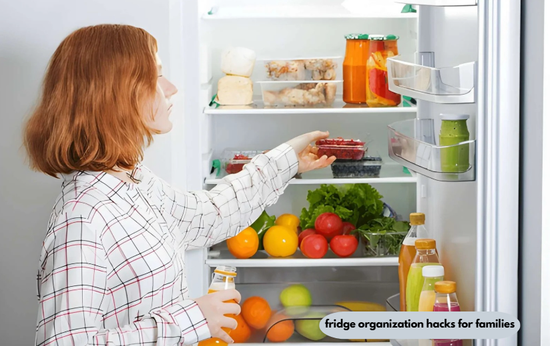
Fridge Organization Hacks for Families: 12 Easy Ways to Keep Food Organized
The best fridge organization hacks for families assign every food a fixed zone: ready-to-eat items up top, raw meat on the lowest shelf, and an “Eat First” bin at eye level. Keep the fridge at 40°F or below, label leftovers with dates, and reset the shelves once a week.
A family fridge gets opened all day long by people of different heights, appetites, and patience levels. The 12 hacks below are built for that reality: they take minutes, cost little, and still work when a seven-year-old is the one putting the yogurt back.
Key Takeaways
- The U.S. Food and Drug Administration advises keeping a refrigerator at 40°F or below and a freezer at 0°F.
- The Environmental Protection Agency’s April 2025 report puts the cost of wasted food at $2,913 a year for a household of four, or about $56 a week.
- FoodSafety.gov’s Cold Food Storage Chart gives cooked leftovers 3 to 4 days in the fridge and raw ground meat or poultry only 1 to 2 days.
- Raw meat belongs on the lowest shelf in a rimmed tray so its juices cannot drip onto food that will not be cooked.
- California’s AB 660, in force since July 1, 2026, removes consumer-facing “sell by” dates and limits labels to a quality date or a safety date.
What are the best fridge organization hacks for families?
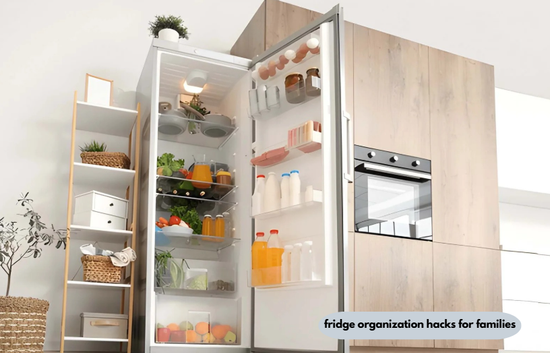
The 12 hacks that hold up in a busy household all do one of three jobs: keep food cold, keep food visible, or make the right spot obvious to everyone. Start at the top of the list, because the first three protect food safety, and the rest build on them.
- Put a thermometer on the middle shelf. The FDA notes that most fridge dials do not display a real temperature, so an inexpensive appliance thermometer is the only way to confirm 40°F or below.
- Map your zones before buying a single bin. Decide where leftovers, dairy, raw meat, produce, and snacks live, then measure the shelves. Bins bought first rarely fit.
- Park raw meat on the lowest shelf in a rimmed tray. A leak then stays in the tray instead of running onto fruit or lunch food below it.
- Add an “Eat First” bin at adult eye level. Half an onion, the open hummus, and yesterday’s pasta go here. Anyone hunting for a snack checks this bin before opening something new.
- Date every leftover with tape and a marker. Write the day it was cooked. Rice made on Sunday is due by Thursday under the 3-to-4-day guidance from FoodSafety.gov.
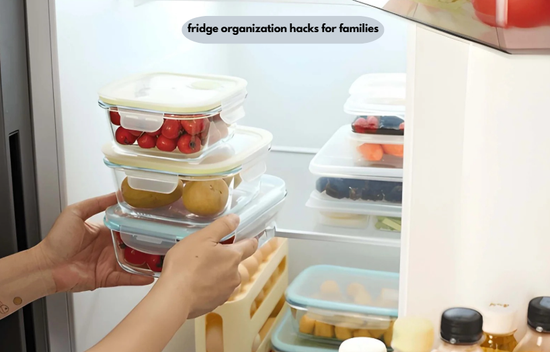
- Store leftovers in shallow, same-size containers. The FDA advises splitting hot food into smaller containers so it chills faster, and matching lids let you stack three high without a landslide.
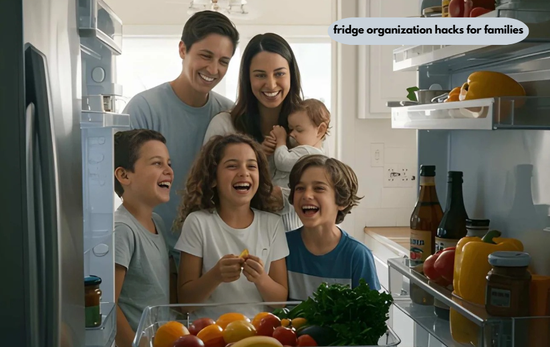
- Give kids one snack bin at their height. Cheese sticks, washed grapes, and yogurt tubes in a low bin end the open-door staring contest and keep small hands away from the raw-meat shelf.
- Group by category in clear, labeled bins. A “breakfast” bin and a “lunchbox” bin slide out like drawers, so nothing hides at the back wall.
- Put jars on a turntable. One spin shows every sauce, which stops the purchase of a third jar of mustard.
- Keep milk and eggs off the door. The door swings into warm kitchen air every time it opens, so save it for condiments, juice, and butter.
- Leave gaps between items. Cold air has to move around food to chill it, according to the FDA, so a shelf packed wall-to-wall cools unevenly.
- Load groceries oldest-in-front. New yogurt goes behind the open tub. This single habit is the cheapest of all the kitchen hacks that save time and money.
Where Should You Store Different Foods in the Refrigerator?
Ready-to-eat food goes high, raw animal products go low, produce goes in the drawers, and the door holds only items that tolerate temperature swings. The table pairs each zone with the fridge life listed in FoodSafety.gov’s Cold Food Storage Chart, so the label on the shelf also tells you how fast to use what sits there.
| Zone | What lives here | Fridge life at 40°F or below | Why this spot |
| Top shelf | Cooked leftovers, soups, pizza | 3 to 4 days | Nothing raw sits above it to drip |
| Eye-level shelf | “Eat First” bin, opened lunch meat | 3 to 5 days for opened lunch meat | Seen first, eaten first |
| Middle shelf | Eggs in their carton, milk, yogurt | 3 to 5 weeks for raw eggs in the shell | Steadier cold than the door |
| Lowest shelf | Raw ground meat and poultry in a tray | 1 to 2 days | Leaks stay contained |
| Lowest shelf | Raw steaks, chops, roasts | 3 to 5 days | Same tray, separate from poultry |
| Door | Condiments, juice, butter | Check the package. | Warmest part of the fridge |
Crisper drawers work best when one holds fruit and the other holds vegetables. Splitting them makes each drawer shallow enough to see the bottom, which is where forgotten cucumbers turn to liquid. These tips follow the rule behind every ImpoCoolMom life guide: the system has to work for the least careful person in the house.
How Much Money Does Food Waste from a Disorganized Fridge Cost?
A family of four loses about $56 a week to uneaten food, based on the Environmental Protection Agency’s April 2025 report, Estimating the Cost of Food Waste to American Consumers. That adds up to $2,913 a year, which the agency equates to roughly 11 percent of the household’s food spending.
Here is the math on what an “Eat First” bin and dated leftovers are worth. Dividing $2,913 by 52 weeks gives $56. If visible, labeled food lets a family rescue just one quarter of that; the saving is $14 a week, or $728 over a year.
That $728 is an illustration, not a promise. The EPA figure counts all food a consumer pays for and does not eat, including restaurant plates, so the fridge accounts for only part of the total.
A second estimate measures the same problem differently. BioCycle reported in May 2025 that ReFED put consumer food waste at $780 per person for 2023, using sources such as residential waste surveys, while the EPA’s $728 per person comes from federal food availability data. The two numbers are close, yet they are not interchangeable.
Why does my fridge get messy again after a week?
A fridge slides back into chaos when the system depends on one person remembering where things go. The usual cause is buying matching bins first and assigning them jobs later.
The mistake happens because bins look like the solution in photos. In a real kitchen, a bin with no label becomes a junk drawer within days, and deep bins hide food as well as the back of the shelf did.
The fix takes three steps. Empty one shelf, name its zone out loud with the family, and stick a label on the shelf edge itself, not only on the bin. A label on the shelf survives when the bin is in the dishwasher. The same advice applies to most life hacks: a rule only one person knows does not last.
The second cause is volume. A fridge filled to the walls blocks airflow, so if groceries never fit, shop for five days instead of seven before buying more containers.
How do you organize a small fridge for a big family?
In a small fridge, use height and remove packaging. Most easy storage hacks for small homes apply inside the fridge too: stack, hang, and decant.
- Take yogurt cups, string cheese, and juice boxes out of cardboard sleeves, which waste inches on every side.
- Add one stackable shelf riser to split a tall shelf into two short ones.
- Lay bottles in a stackable rack instead of standing them where they block the view.
- Freeze the second half of any family-size pack of meat the day you buy it, since raw poultry and ground meat have only 1 to 2 days in the fridge.
- Keep whole onions, potatoes, and unopened shelf-stable sauces in a cupboard to free a full shelf.
How often should you clean and reset the fridge?

Reset the fridge once a week, the day before you shop, and wipe spills the moment they happen. The weekly reset takes about as long as unloading the dishwasher when the zones are already labeled.
Among cleaning hacks for busy moms, the most useful is a washable liner or a sheet of paper towel under the raw-meat tray and in each crisper drawer. A spill then lifts out in one piece instead of needing a full shelf scrub.
Run the reset in the same order every week: pull everything past its date, move near-due food to the “Eat First” bin, wipe the shelf under it, then write the shopping list from what is missing. The list written last is shorter, because you have just seen what you already own. Like other ImpoCoolMom hacks, the reset belongs to the tips and tricks that improve your life by removing a decision, not by adding a chore.
The “eat the oldest first” rule has limits. After a power outage, the FDA says food that sat above 40°F for more than two hours should be thrown out, no matter how recently it was cooked or how neatly it was stored. A “USE by” date is also a safety date under California’s 2026 labeling rules, so it is not treated like a “BEST if Used by” quality date that food often outlasts.
Frequently Asked Questions
What temperature should a family fridge be set to?
Set the refrigerator to 40°F or below and the freezer to 0°F, which are the levels the FDA recommends. Check with a standalone thermometer on the middle shelf, since a dial marked 1 to 5 shows a setting and not degrees.
How long do leftovers last in the fridge?
Cooked leftovers stay good for 3 to 4 days in the fridge, according to FoodSafety.gov’s Cold Food Storage Chart. Writing the cooking day on the lid removes the guesswork, and anything you will not finish in that window belongs in the freezer.
Should hot food cool on the counter before going in the fridge?
No, hot food goes straight into the fridge, and the FDA states that doing so does not damage the appliance. Leftovers need to be chilled within two hours, so divide a big pot into shallow containers to speed cooling.
Where should raw chicken go in the fridge?
Raw chicken goes on the lowest shelf, inside a rimmed tray or sealed container. Cook or freeze it within 1 to 2 days, which is the fridge life FoodSafety.gov lists for fresh poultry.
How do I get kids to keep the fridge organized?
Give children one labeled bin at their own height and make it the only place they need to reach. A child who owns a bin puts things back in it, which keeps the other shelves intact.
What do the new food date labels mean?
“BEST if Used by” marks peak quality, and “USE by” marks a safety limit. California’s AB 660 made these the standard terms for food manufactured on or after July 1, 2026, and the Natural Resources Defense Council describes it as the first state ban on consumer-facing “sell by” dates.
Conclusion
The fridge organization hacks for families that last are the ones a child can follow: one zone per food type, one label per shelf, one bin for what gets eaten first. A thermometer reading of 40°F or below and a date on every leftover do more for safety than any set of matching containers. Set the zones once, and a short weekly reset keeps them in place.