
Grocery Shopping Hacks to Save Money on a Tight Budget
The best grocery shopping hacks to save money are planning meals around sale flyers, comparing unit prices, switching to store brands, and wasting less of what you buy. A family of four can save about $260 a month by changing how it shops and close to $325 if it also cuts food waste in half.
Key Takeaways
- Unit price, printed on most U.S. shelf tags, shows which package truly costs less per ounce, pound, or count.
- Store brands are usually cheaper than national brands in the same category, and they must meet the same federal food-labeling rules.
- Food a household throws away still counts as money spent, so planning portions protects a budget as much as coupons do.
- A family of four that shifts its spending from the USDA Moderate-Cost level to the Low-Cost level saves about $262 a month at fall 2026 prices.
- Bulk buying saves money only on items a household finishes before they spoil.
What Are Grocery Shopping Hacks?
Grocery shopping hacks are simple habits you repeat when planning, buying, and storing food, and they cut your overall food costs without sacrificing nutrition.
How Much Should a Family Spend on Groceries in 2026?
A family of four with school-age children typically needs between $1,000 and $1,700 a month for groceries. Where you land depends on location, the ages of your kids, and how much you cook from scratch.
Prices keep rising. The USDA Economic Research Service’s October 2026 Food Price Outlook forecasts that grocery prices will end 2026 up 2.3% over 2025. On a $1,200 monthly cart, that adds about $27.60 a month, or roughly $331 a year, for identical food.
Federal food plans offer a fair yardstick, since each one prices a healthy, fully home-cooked diet at a different spending level.
| USDA food plan, family of four | Monthly cost, Sept. 2026 | Yearly cost | Extra per month vs. U.S. Thrifty | Source |
| Thrifty, U.S. average | $1,024.00 | $12,288 | $0 | USDA Food and Nutrition Service, Monthly Cost of Food Report, Sept. 2026 |
| Low-Cost, U.S. average | $1,126.90 | $13,523 | $102.90 | Calculated from USDA age-group costs, Sept. 2026 |
| Moderate-Cost, U.S. average | $1,389.20 | $16,670 | $365.20 | Calculated from USDA age-group costs, Sept. 2026 |
| Liberal, U.S. average | $1,681.80 | $20,182 | $657.80 | Calculated from USDA age-group costs, Sept. 2026 |
| Thrifty, Anchorage | $1,296.90 | $15,563 | $272.90 | USDA Food and Nutrition Service, Monthly Cost of Food Report, Sept. 2026 |
| Thrifty, Hawaii | $1,573.60 | $18,883 | $549.60 | USDA Food and Nutrition Service, Monthly Cost of Food Report, Sept. 2026 |
A family of four means two adults aged 20 to 50 plus children aged 6 to 8 and 9 to 11. The Anchorage and Hawaii rows price the same Thrifty menu in costlier markets, so their gap reflects geography rather than food choices.
Pull your last three months of receipts and divide by three. Landing above the Moderate-Cost line signals plenty of room to cut, while landing near Thrifty means waste control will matter more than brand switching. Repeat the check every quarter, the same first step Impocoolmom uses before building any family budget.
What Are the Best Grocery Shopping Hacks to Save Money?
The best hacks attack price, quantity, and waste in one weekly routine. Each step costs nothing to start, a standard every one of the impocoolmom hacks has to meet.
- Shop your kitchen first. Check the fridge, freezer, and pantry, then build two dinners around what already sits there.
- Plan meals from the weekly ad. Choose the proteins on sale, then pick recipes, never the reverse.
- Write a list sorted by store section. A route-ordered list keeps you out of the aisles where impulse buys live.
- Compare unit prices, not sticker prices.
- Default to the store brand. Pay for the national label only when your family genuinely rejects the swap.
- Load digital coupons before you leave. Clip them in the store app so they apply automatically at the register.
- Keep a price book. Note the lowest price you see on your 15 most-bought items, and stock up only when a sale matches it.
- Set a hard spending cap. A fixed number forces trade-offs at the shelf instead of regret at checkout.
How Do You Compare Unit Prices Correctly?
Divide the shelf price by the package quantity, or read the unit-price line on the tag. Compare only tags that use the same unit, because some stores price one brand per ounce and its neighbor per count.
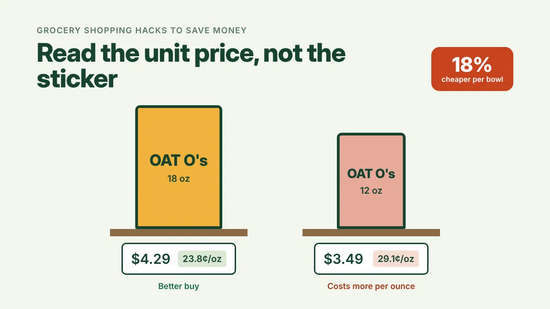
Picture two cereal boxes. An 18-ounce box at $4.29 works out to about 23.8 cents per ounce, while a 12-ounce box at $3.49 costs about 29.1 cents per ounce. The bigger box is roughly 18% cheaper per bowl.
Are Store Brands Really Cheaper Than Name Brands?
Yes. In most grocery categories, store brands cost noticeably less, and national-brand manufacturers produce many of them.
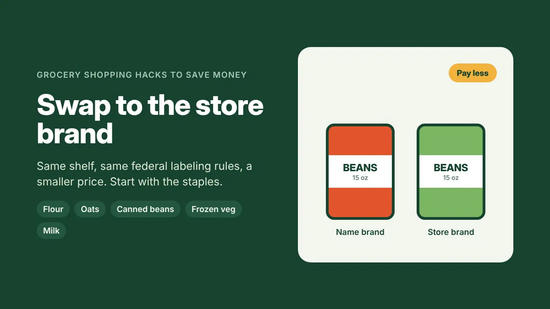
Store-brand items averaged $4.18 in 2025 versus $4.69 for national brands, according to Private Label Manufacturers Association (PLMA) data from Circana. Across the 68.7 billion store-brand units sold, that gap adds up to roughly $35 billion in shopper savings. Your slice of that depends entirely on how many swaps you make. Start with staples where taste barely differs: flour, sugar, oats, canned beans, frozen vegetables, and milk.
Keep a short brand-only list for the two or three products your family truly notices. Swap everything else. It’s also one of the simplest life hacks to test: try one new store-brand item per trip and keep it if nobody complains.
How Can You Stop Wasting Food You Already Paid For?
Buy only for meals you have planned, store produce correctly, and eat the oldest food first. Waste quietly cancels out every coupon you clip.
The U.S. Department of Agriculture has long estimated that an average family of four loses about $1,500 a year to uneaten food. Cut that loss in half and you recover $750 a year without changing one brand. Read date labels correctly, too: a best if used By date marks peak quality, not safety, so most shelf-stable food stays safe past it, with infant formula as the key exception.
Which Kitchen Hacks Save Time and Money?
The kitchen hacks that save time and money turn one cooking session into several meals.
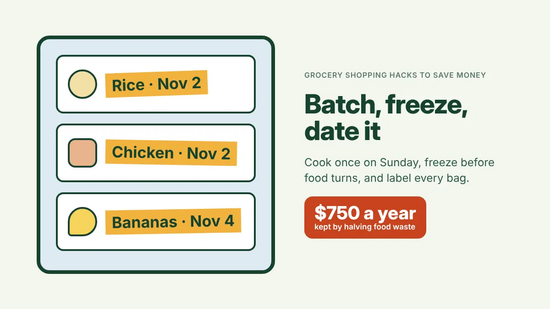
- Batch-cook a grain and a protein on Sunday, then remix them into bowls, tacos, and soup.
- Freeze bread, shredded cheese, and overripe bananas before they turn.
- Stand herbs in a jar of water and wrap salad greens in a dry paper towel to slow wilting.
- Date every freezer bag with masking tape and a marker so nothing becomes mystery food.
The Bulk-Buying Mistake and How to Fix It
The costliest mistake on a tight budget is grabbing the jumbo pack because its unit price looks unbeatable. A 3-pound clamshell of spinach at $6.99 beats a 1-pound bag at $3.49 on paper, at about $2.33 per pound. Eat only one pound before the rest wilts, though, and you paid double for the same salad.
The fix is simple. Buy bulk only for shelf-stable or freezable goods, and freeze or share half of any big perishable pack the day you bring it home.
How Much Can These Hacks Save a Family in a Year?
A family of four that combines these habits can save roughly $3,100 to $3,900 a year. Here is the math at fall 2026 food-plan costs:
- Shifting from moderate-cost to low-cost food-plan spending saves $262.30 a month, or $3,147.60 a year.
- Halving typical household food waste adds another $750 a year.
- Together, that totals $3,897.60, close to $325 a month.
That stacking effect is why the best money saving hacks for families are built around routines instead of one-time deals. Redirect the $325 into savings each month, and it builds a $3,900 emergency cushion within a year.
When Does This Advice Not Apply?
Standard savings rules bend for families with special constraints. If you’re working out how to improve your life on a tight budget, start with the rules that fit your own household. Families managing food allergies, celiac disease, or a medical diet often cannot swap brands or proteins freely, so their savings come from waste control and planning, while households in rural areas, Alaska, or Hawaii face higher prices and fewer competing stores, which makes freezer stocking worth more than ad-chasing. Anyone without a working freezer or a car should lean on shelf-stable staples such as dried beans, rice, oats, and canned fish.
Frequently Asked Questions
What day of the week is cheapest for grocery shopping?
Wednesday is often a good day at chains that start their weekly ads midweek, because some briefly honor both the outgoing and incoming sale prices. Check your chain’s ad cycle in its app.
Is buying in bulk always cheaper?
No, bulk buying saves money only when your household uses everything before it spoils. Freezable and shelf-stable items make the safest bulk purchases.
How can I save money on groceries without coupons?
Switch to store brands, plan meals around weekly sales, and cut food waste. None of those habits requires clipping anything, and most manufacturer coupons target national brands anyway.
How much should a family of four budget for groceries each month?
Most families of four need $1,000 to $1,700 a month, depending on location, children’s ages, and how much they cook from scratch. Compare your real spending with the federal food plan levels, then aim one level lower.
Do grocery store apps actually save money?
Yes, grocery apps save money when you load digital coupons and check loyalty prices before shopping. Many chains reserve their lowest shelf prices for members, so skipping the app means paying more for identical items.
Conclusion
The grocery shopping hacks to save money that work best are deliberately boring: plan from the ad, read unit prices, buy store brands, and finish what you buy. Repeat them every week, and a family of four can keep roughly $325 a month that used to disappear at checkout.
Pingback: Budget Friendly Meal Planning Hacks: Save Money and Reduce Food Waste Impocoolmom Hacks