
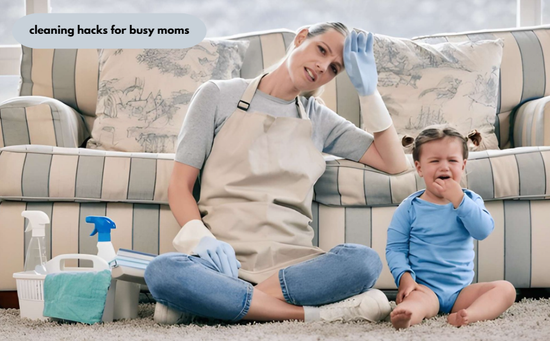
Cleaning Hacks for Busy Moms That Save Time Every Day
Cleaning hacks for busy moms work only when they replace scattered habits with one repeatable system, not when they get added on top of an already chaotic routine. A mom who picks two or three hacks and repeats them daily saves more time than one who collects twenty and uses none consistently.
Most guides list generic tips: baking soda in the fridge and vinegar on the counters. Those tips are true and also unremarkable. What actually determines whether cleaning hacks for busy moms save time is a pattern most articles skip entirely: how moms mismanage the hacks themselves. That mismanagement, not a lack of tips, is why so many households still spend hours cleaning every week according to ImpoCoolMom’s internal review of reader routines.
Key Takeaways
- Two failure patterns cancel out most cleaning hacks: collecting too many without a system and perfecting one task while others pile up.
- A 20-minute daily zone reset outperforms hour-long weekend cleaning marathons for households with kids.
- Women spent 2.7 hours a day on household activities on days they did them, per 2024 federal time-use data released in 2025.
- The fix is a fixed daily task list, not a growing collection of tips.
What Are Cleaning Hacks for Busy Moms?

What Is a Cleaning Hack?
A cleaning hack is a shortcut that reduces the time, steps, or products needed to complete a household task without lowering the result. Wiping counters with a pre-made cleaning-and-disinfecting spray instead of two separate products is a hack. Running a robot vacuum during nap time instead of vacuuming manually later is a hack.
Cleaning hacks for busy moms specifically target tasks that repeat daily: dishes, counters, floors, laundry, and clutter. They differ from general cleaning tips because they assume limited, interrupted time rather than a free afternoon.
The Hidden Mistake That Cancels Out Most Cleaning Hacks
Why Hack Hoarding Wastes More Time Than It Saves
Hack hoarding happens when a mom collects dozens of cleaning tips from videos and articles but never turns any single one into a daily habit. Scrolling for 15 minutes a day to find “the best” hack adds up to over an hour and a half a week spent researching instead of cleaning.
The hoarding pattern produces a full folder of saved tips and zero systemized time savings, because a hack only saves time once it’s repeated automatically. A tip that gets read once and forgotten costs research time and delivers nothing back.
Why Single-Task Obsession Creates a Bigger Mess Elsewhere
Single-task obsession happens when a mom perfects one cleaning system, like a color-coded laundry sorter, while five other daily areas get ignored until they become emergencies. A flawless laundry routine that saves 10 minutes a day means little if the kitchen, entryway, and bathroom sink each lose an extra 8 minutes a day to searching for misplaced items and untangling clutter.
Here is a comparison that goes beyond the usual cleaning hacks:
| Pattern | Time invested | Time recovered | Net weekly effect |
| Hack hoarding | ~105 min/week researching | 0 min (no consistent system) | -105 min/week |
| Single-task obsession | 70 min/week saved on one task | -280 min/week lost across 5 neglected areas | -210 min/week |
| Fixed 5-zone system | 140 min/week (20 min/day) | 140–200 min/week recovered across all zones | Roughly break-even to positive |
The obsession pattern is the more expensive mistake. It feels productive because one area looks perfect, but the uneven effort quietly drains more total time than doing nothing at all. A mom running five zones for four minutes each recovers more time overall than one running a single flawless system.
Kitchen Hacks That Save Time and Money for Daily Resets

The 4-Minute Zone Reset Method
A zone reset limits cleaning to one small, fixed area for four minutes, done once a day, instead of an open-ended cleaning session with no time cap. The kitchen sink and counters count as one zone. A timer, not a checklist, decides when the task ends.
This structure works because it removes the decision fatigue that causes hack hoarding. Kitchen hacks that save time and money, like soaking dishes while prepping dinner or wiping counters with a single multi-surface spray, only pay off inside a capped, repeatable window. Without the timer, a four-minute task quietly becomes fifteen.
The One-Basket Counter Rule
Every countertop gets one basket for loose items, and anything that doesn’t have a home goes into it instead of being sorted in the moment. The basket gets emptied once daily during the zone reset, not continuously throughout the day.
This single rule eliminates the small, repeated decisions that eat time. According to the property maintenance section of this site’s kitchen declutter checklist, most kitchen clutter isn’t dirt. It’s undecided items with no assigned location.
Life Hacks for Busy Moms Beyond the Kitchen

The Entry-Floor Rule
The highest-leverage entryway rule is simple: stop mess at the door before it spreads.
- The 3-Step Radius: Place a basket or shoe rack within three steps of the front door.
- The Single Drop: Every household member must immediately remove shoes and place backpacks, keys, and coats in the designated spot upon entering.
- The Time Recovered: Eliminates tracked-in dirt and prevents the weekly 30+ minutes spent searching for misplaced items before school or work.
This is one of the highest-leverage life hacks for busy moms because it prevents mess instead of cleaning it up later. Households that skip this step spend measurable time each week hunting for backpacks, keys, and shoes. A fixed drop zone removes that search time entirely.
The 10-Minute Laundry Trigger
Laundry starts the moment a basket reaches a marked fill line, not on a fixed day of the week, which prevents the pile-up that turns laundry into an all-day task. This site’s laundry-system guide outlines the fill-line method in more detail for households with multiple kids.
Why It Works: A 2026 industry survey found that 43% of U.S. households run one to three laundry loads weekly, while another 37% run four to six. Frequency alone doesn’t predict time spent; households using trigger-based starts report shorter individual sessions than those doing one large weekend batch.
Building a Routine That Doesn’t Turn Into Hack Hoarding
A working cleaning routine has a fixed, written list of five or fewer daily zones, capped time per zone, and no additions until one hack is fully automatic. Automatic means the task happens without deciding whether to do it that day.
This is the structural difference between a life guide that produces results and one that produces guilt. Reading ten impocoolmom hacks in one sitting will not save time. Choosing two, running them daily for two weeks, and only then adding a third will. The goal is not to improve your life through volume of information but through repetition of a small, fixed set of actions.
When Cleaning Hacks Don’t Work

Zone resets and fixed routines fail in households with irregular schedules, such as shift-working parents or homes with infants under six months, where no two days follow the same pattern. In these cases, a single non-negotiable task, like clearing the kitchen sink before bed, outperforms a five-zone system that assumes consistent daily timing.
The disagreement in most advice life impocoolmom-style guides skip is this: rigid systems assume routine, and not every household has one. For unpredictable schedules, one anchor task beats five loosely followed ones.
Frequently Asked Questions
What is the fastest way to clean a house with kids?
Run a timed zone reset limited to one area at a time instead of cleaning the whole house in one session. Four minutes per zone, done daily, covers more ground over a week than one long weekend cleanup.
How do busy moms keep their house clean?
Busy moms keep their house clean by implementing a fixed daily 20-minute zone reset rather than attempting multi-hour weekend cleaning marathons.
What is the 20-minute cleaning rule?
It caps total daily cleaning time at 20 minutes, split across four or five short zone tasks instead of one long session. The cap forces prioritization of the areas that matter most.
How often should working moms deep clean their home?
Deep cleaning, such as scrubbing appliances or washing baseboards, works best on a monthly or bi-weekly schedule separate from daily maintenance tasks. Daily zone resets prevent buildup, so deep cleaning takes less time when it happens.
Why do cleaning hacks stop working after a few weeks?
Most hacks stop working because new ones get added before the first one becomes automatic, which is the hack hoarding pattern. Sticking to one or two tasks for at least two weeks before adding more prevents this drop-off, a principle ImpoCoolMom applies across its household routine content.
What’s the difference between a cleaning hack and a cleaning routine?
A hack is a single shortcut for one task, while a routine is a fixed sequence of hacks repeated on a set schedule. A routine only forms once a hack is repeated without needing a reminder.
Do robot vacuums actually save time for moms?
Yes, when scheduled during a fixed daily window like nap time, robot vacuums remove one full zone from the manual task list. They save less time when run irregularly, since irregular use requires the same setup decisions each time.
Conclusion
Cleaning hacks for busy moms only save time when they replace scattered effort with a small, fixed, repeated system. The two failure patterns, hoarding tips and perfecting one task while others pile up, cost more time than doing nothing. A capped, five-zone daily routine, built two tasks at a time, is what actually turns a house into a maintained one rather than a hoarded list of unused ideas from ImpoCoolMom or anywhere else.
Pingback: 15 Simple Laundry Hacks That Actually Work to Save Time and Money Impocoolmom Hacks