
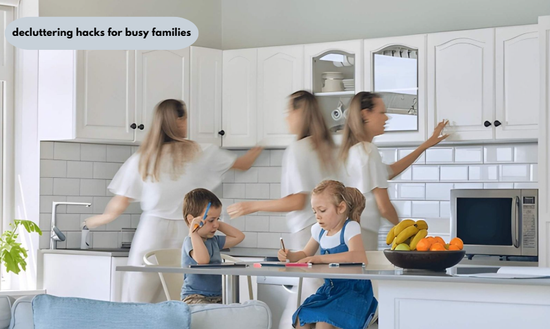
15-Minute Decluttering Hacks for Busy Families: Simple Routines That Work
Decluttering hacks for busy families are micro-organizing techniques designed to keep a household tidy in under 15 minutes a day. Unlike major weekend overhauls, these strategies focus on zone-based storage, strict item limits, and daily micro-decisions that stop clutter before it accumulates. The most effective systems pair a short daily reset with a one-in-one-out rule and zone-based storage.
Busy families lose time to clutter in small, repeated moments, not one big mess—misplaced items and duplicate purchases quietly cost real hours and dollars. This guide covers the sequencing mistake that undoes most decluttering attempts, plus decluttering hacks for busy families that fit inside nap time or a drop-off gap, including additional impocoolmom hacks for routines that survive a chaotic week.
Key Takeaways
- A 15-minute daily reset outperforms occasional multi-hour cleanouts for busy households.
- 71% of Americans have repurchased an item they already owned because they couldn’t find it, per Storable’s 2025 clutter survey.
- Median new single-family homes shrank to 2,176 square feet in Q3 2025 (NAHB/Census data), making per-square-foot organization more important than ever.
- The most common mistake is buying storage bins before purging, which organizes clutter instead of removing it.
- Zone-based systems (landing zone, toy rotation, paper station) beat one-time purges for daily decision-making.
What Is Decluttering, and Why Does It Matter for Busy Families?

Decluttering is the deliberate removal of unused, duplicate, or unnecessary items from a living space, distinct from organizing, which arranges what remains. For a household with kids, every extra item is a future decision: keep it, store it, or explain why it’s not staying on the kitchen table.
A 2025 Censuswide/ECOVACS survey found clutter cited as a top cleaning obstacle by 24.8% of U.S. adults, rising to 27.9% among millennials—a group that skews toward young families. A separate 2025 YouGov survey found 40% of U.S. adults describe their living environment as cluttered overall. These measure different things—a specific cleaning obstacle versus general self-perceived clutter—and shouldn’t be treated as interchangeable.
The Real Cost of Clutter: A Decluttering Debt Calculation
How Much Time Does Clutter Actually Cost a Family Each Year?
A family making five small clutter-related decisions a day, at roughly 15 seconds of friction each, loses close to eight hours a year to decision fatigue alone. This is an original calculation from stated assumptions (5 decisions/day × 15 seconds × 365 days ≈ 7.6 hours/year), not a published statistic, and it excludes actual cleanup time.
That figure covers mental friction only — deciding where an item goes or where it was last seen. Searching and reorganizing add more on top. Treated as recurring “decluttering debt,” the fix mirrors personal finance: small, consistent payments beat rare, large ones.
What the Storable 2025 Survey Reveals About Repeat Purchases?
Storable’s 2025 clutter survey found that 71% of Americans have bought an item a second time because they couldn’t find the original one. That single data point turns clutter from an aesthetic complaint into a household budget line item.
Repurchasing even three misplaced items a year at $25 each is $75 in avoidable spending — before counting search time or a lost permission slip on the morning it’s due. The same survey found 21% of Americans now dedicate over 500 square feet purely to storage, a figure that matters more as new-home sizes shrink.
The #1 Mistake Busy Parents Make When Decluttering
Why Buying Storage Bins First Backfires
Buying storage bins before removing unused items results in tidier clutter, not less of it. This sequencing mistake is the single most common pattern across busy households attempting a weekend organizing project.
A bin or drawer divider makes a mess look contained, which removes the pressure to actually purge. The clutter is still there, just relocated into a labeled container it often stays untouched for months. Organizers call this outcome clutter containment, not clutter reduction.
The Fix: Purge Before You Organize
Remove items first, then buy storage only for what remains, sized to the leftover quantity rather than an assumed need. This one sequencing change beats any specific bin or shelving system.
- Pull everything out of the target zone (drawer, closet, toy bin).
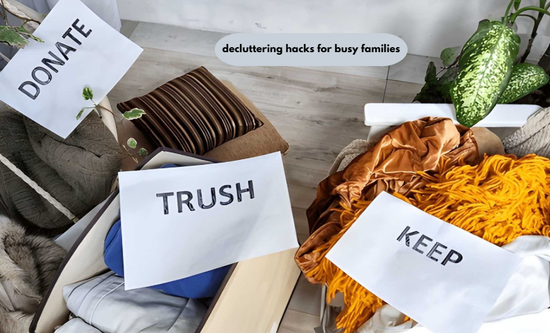
- Sort into keep, donate, and trash — no “maybe” pile; maybe items get donated.
- Only then measure what’s left and buy storage sized to fit.
Decluttering Hacks for Busy Families That Take 15 Minutes or Less
The Daily Reset Method
A daily reset is a fixed 10-to-15-minute window, done at the same time each day, where every out-of-place item returns to its zone. It works because it stops clutter from building past the point a quick fix can handle.
Set a timer, pick one time of day (after dinner works well), and stop when it rings—an incomplete reset still counts as progress.
The One-In, One-Out Rule
For every new item that enters the home, one existing item in the same category leaves. This caps household volume without a separate decluttering session later.
- New shoes in → one old pair donated same week
- New toy in → one toy leaves the bin before bedtime
- New kitchen tool in → one duplicate goes to donation
The Four-Box Sprint
A four-box sprint uses four labeled boxes—keep, donate, trash, and relocate—and a 20-minute timer to clear one zone completely before moving on. It works for entryways, playrooms, and pantries because it forces a decision on every item touched.
- Label boxes: Keep, Donate, Trash, Relocate.
- Set a 20-minute timer for one zone only.
- Touch each item once and box it—nothing gets set aside “to think about.”
Organizing Tight Spaces: Apartments, Nurseries, and Shared Rooms
Small-space organization depends on vertical storage, multi-use furniture, and zones defined by activity rather than by room. With median new single-family homes down to 2,176 square feet as of Q3 2025 (NAHB/Census data) and many families in even smaller rented spaces, per-square-foot efficiency matters more than before.
Families searching for home organization hacks for small spaces get the fastest results from three moves: shelving mounted above furniture instead of floor units, door-back storage for shoes or craft supplies, and a single “landing zone” near the entrance for shoes, bags, and mail.
Building Habits That Stick When You Have Zero Free Time
Habits stick when they’re attached to an existing routine, take under 15 minutes, and have a visible trigger, like a timer or a spot by the door. Willpower-based systems fail for busy households because willpower is already depleted by mid-afternoon.
Many of the most searched life hacks for busy moms are really habit-stacking: pairing the daily reset with something that already happens daily, like brushing teeth. Parents typing how to improve your life impocoolmom into a search bar are usually after this kind of low-effort system, not a new product.
Decluttering Systems Compared
| System | Time Investment | Best For | Maintenance Level |
| Daily Reset | 10–15 min/day | Ongoing upkeep in any home | Low, but daily |
| One-In, One-Out | Seconds per purchase | Preventing volume growth | Very low |
| Four-Box Sprint | 20 min per zone | One-time deep clean of a specific area | Medium, occasional |
| Full Weekend Purge | 4–8 hours | Major life transitions (move, new baby) | High, infrequent |
When These Rules Don’t Apply

Sentimental items and keepsakes from a child’s early years don’t respond well to speed-based systems like the four-box sprint. Rushing a decision on a baby blanket or a grandparent’s gift creates regret, not progress. For that category, a single memory box per child, revisited once a year with a hard size limit instead of a time limit, works better. Stating the general purge-fast rule without naming where it fails doesn’t match how real households actually operate.
Frequently Asked Questions
How do I start decluttering when I don’t have time?
Start with a single 15-minute daily reset instead of a big cleanout. Pick one zone — the kitchen counter or entryway — and reset it at the same time daily until it’s automatic, then add a second zone.
What is the four-box decluttering method?
It uses labeled boxes for keep, donate, trash, and relocate, plus a short timer, to force a decision on every item in one zone. It’s designed to prevent the “maybe” pile that stalls most attempts.
How often should a busy family declutter?
Daily micro-resets should happen every day, while a deeper sort of any given zone works well seasonally, about four times a year. Waiting longer lets clutter debt build past the point a quick reset can fix.
What’s the difference between decluttering and organizing?
Decluttering removes items; organizing puts what’s left in order. Doing them in the wrong order — organizing before decluttering — is the most common mistake busy parents make, since it hides clutter instead of reducing it.
Should I buy storage bins before or after decluttering?
Always after, sized to whatever is left once unused items are removed. Buying bins first tends to produce a tidier version of the same clutter.
How do I get kids to declutter their own toys?
Give a visible limit, like “toys must fit in this one bin,” instead of an abstract “clean up.” A one-in, one-out rule tied to birthdays and holidays keeps volume from creeping back up.
Is decluttering worth it if my house isn’t visibly messy?
Yes—clutter’s cost shows up in decision time and duplicate purchases even in a tidy-looking home. Storable’s 2025 survey found 71% of Americans have repurchased an item they already owned simply because they couldn’t locate it.
Conclusion
Decluttering hacks for busy families work when they replace rare, large efforts with small, consistent ones: a 15-minute daily reset, a one-in, one-out rule, and storage bought only after the purge. The measurable cost of skipping this—repurchased items, wasted search time, and storage space—makes the case for a system, not a single weekend cleanout.
Families that fix their sequencing and adopt a daily reset typically see a calmer home within a few weeks. ImpoCoolMom’s daily reset framework, outlined above, is built to work inside the gaps busy parents already have.
Pingback: Easy Kitchen Hacks That Save Time and Money: Smart Tips for Every Home Impocoolmom Hacks