
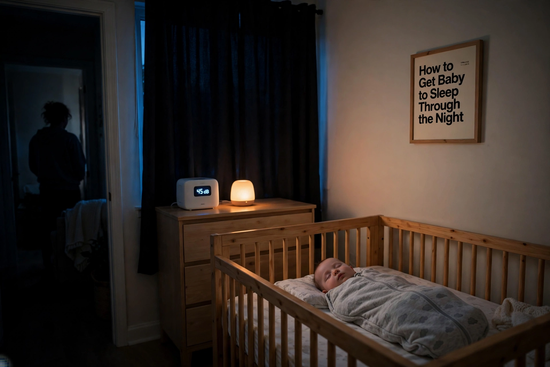
How to Get Baby to Sleep Through the Night: 12 Gentle Tips for Better Sleep
Learning how to get baby to sleep through the night comes down to three habits: a predictable bedtime routine, putting your baby down drowsy but awake, and a bedtime matched to age-based sleep needs. Most babies stretch night sleep between 6 and 12 months, and steady consistency beats quick fixes.
Key Takeaways
- Babies under 4 months wake at night to feed because their stomachs are small and their body clocks are still forming.
- A 20- to 30-minute bedtime routine, done in the same order every night, signals the brain that sleep is coming.
- A baby put down drowsy but awake learns to connect sleep cycles without a parent’s help.
- Overtired babies wake more often, so an earlier bedtime usually lengthens night sleep.
- Every sleep should happen on the back, on a firm, flat surface, with nothing else in the crib.
What Is “Sleeping Through the Night” for a Baby?
For a baby, sleeping through the night means one unbroken stretch of six to eight hours without a parent feeding or resettling them.
Infant sleep cycles last about 45 to 60 minutes, roughly half the length of an adult cycle. Every baby partly wakes between cycles. A baby who “sleeps through” has simply learned to drift back down alone.
When Do Babies Start Sleeping Through the Night?
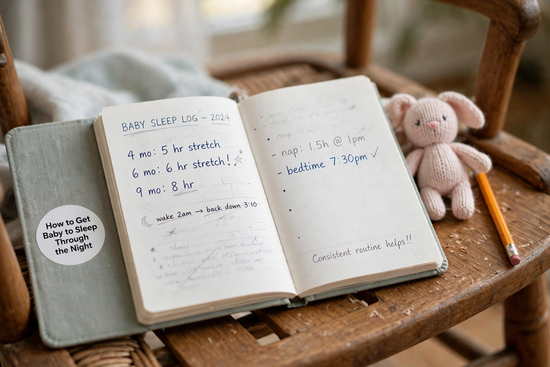
Many babies manage a six-hour stretch between 4 and 6 months, but plenty need until their first birthday or later to hold eight hours. Feeding method, weight gain, and temperament set the pace.
Here is what to expect at each stage:
- 0–3 months: wakes every 2 to 4 hours to feed, with day and night still mixed up.
- 4–6 months: one longer stretch of 5 to 6 hours appears, usually with 1 or 2 feeds.
- 6–9 months: many babies need one feed or none, once the pediatrician confirms steady growth.
- 9–12 months: Most healthy babies get enough calories by day, so night wakings come from habit more than hunger.
| Age | Recommended total sleep per 24 hours, naps included | Babies not yet sleeping 6 hours straight | Babies not yet sleeping 8 hours straight | Source |
| 6 months | 12–16 hours | 37.6% | 57.0% | American Academy of Sleep Medicine; Pennestri et al., Pediatrics |
| 12 months | 12–16 hours | 27.9% | 43.4% | American Academy of Sleep Medicine; Pennestri et al., Pediatrics |
| 13–24 months | 11–14 hours | Not measured | Not measured | American Academy of Sleep Medicine |
The figures measure two different things. The second column is an expert target for total daily sleep. The middle columns show how many real babies had not yet managed one long night stretch, so a 12-month-old can meet the daily target and still wake twice.
The research team behind those night figures, publishing in Pediatrics in 2018, followed 388 infants and found no link between missing the six- or eight-hour milestone and later mental or motor development. Judge progress by total sleep and daytime mood, not by one long block.
Good tips and tricks can’t force this milestone before a baby’s brain is ready. Good habits make it arrive sooner and last longer once it does.
How to Get Baby to Sleep Through the Night: 12 Gentle Tips

Start with the schedule and the room, then move to feeding and self-settling. Change two or three things at a time so you can see which one worked.
- Fix the morning wake time. Keep it within the same 30-minute window daily, because a steady start anchors naps and bedtime.
- Repeat one bedtime routine. Bath, pajamas, feed, one book, one song, crib. Same order, under 30 minutes.
- Move the last feed earlier. Put the bottle or nursing session at the start of the routine so sucking stops being the only way your baby falls asleep.
- Put your baby down drowsy but awake. Heavy eyes, still aware of the crib. This single habit drives most self-settling progress.
- Watch wake windows. A 6-month-old usually handles 2 to 3 hours awake between sleeps, and going past that builds overtiredness.
- Black out the room. Dawn light triggers many 5 a.m. wake-ups, so add darker shades until you can’t see your hand at arm’s length.
- Run steady white noise. Place the machine across the room, at a low volume, about 50 decibels at the crib (the level of a quiet conversation), and at least 7 feet (2 m) away.
- Keep the room cool. Dress your baby in no more than one layer more than you’d wear and use a wearable blanket instead of loose bedding.
- Fill up daytime calories. Full feeds every 2.5 to 3 hours during the day shift, away from 3 a.m.
- Pause before you respond. Wait two or three minutes after the first fuss, since many babies settle between cycles on their own.
- Keep night wake-ups boring. Use dim light, skip the chatting, and change the diaper only if it’s soiled.
- Try a dream feed, then phase it out. A feed at 10 or 11 p.m., given while your baby is mostly asleep, pushes the first long stretch past midnight. Drop it once your pediatrician confirms steady weight gain.
Tips 1, 6, and 7 count as real-life hacks for busy moms. Each needs one setup, then runs on autopilot every night.
When Should You Hold Off on These Tips?
Skip self-settling work if your baby is under 4 months, was born premature, is not gaining weight well, or has reflux under a doctor’s care, because these babies need night feeds and fast responses, and the pediatrician’s feeding plan comes first. Room-sharing changes the method too: the American Academy of Pediatrics’ 2022 safe sleep policy statement advises keeping the crib or bassinet in the parents’ room for at least the first 6 months, so replace the timed pause with a hand on the chest and a soft “shh” from your own bed.
How Do You Calculate the Right Bedtime for Your Baby?
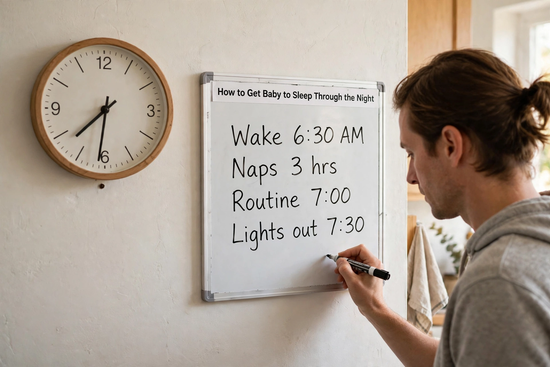
Subtract daytime nap hours from your baby’s total sleep need, then count backward from the morning wake time. The result is a bedtime based on numbers instead of guesswork.
Typical daytime nap totals by age:
- 4–6 months: 3 to 4 naps, about 3 to 4 hours total
- 7–9 months: 2 to 3 naps, about 2.5 to 3.5 hours total
- 10–12 months: 2 naps, about 2 to 3 hours total
Here’s a worked example. A 7-month-old wakes at 6:30 a.m. and naps 3 hours across the day. Aim for 14 hours of total sleep, the midpoint of the infant range in the table.
- Night sleep needed: 14 − 3 = 11 hours
- Count back 11 hours from 6:30 a.m.: lights out at 7:30 p.m.
- Start the 30-minute routine at 7:00 p.m.
Now picture the same baby going down at 9:30 p.m. and still waking at 6:30. That’s 9 hours at night plus 3 naps, or 12 hours, which sits at the bottom of the range and runs 2 hours short of the target daily. Over one week, the gap reaches 14 hours, more than a full night of lost sleep.
If you’re a parent wondering how to improve your life during the baby year, don’t overlook this math. An earlier bedtime returns calm evenings to the adults as well.
What Is the Most Common Mistake That Keeps Babies Waking?
The most common mistake is pushing bedtime later in the hope of a later wake-up. It backfires because an overtired baby has a harder time settling and staying asleep, so they still wake at dawn and add extra night wakings.
Adults who stay up late do sleep in, so parents assume babies work the same way. They don’t.
The fix: move bedtime 15 minutes earlier every three nights until wakings drop, and stop once your baby starts waking before 6 a.m. Among impocoolmom hacks, this one surprises parents most, because it feels backward until the first quiet night.
A second mistake is rushing in at the first squeak. Babies often grunt and cry out briefly between cycles, and a quick pickup teaches them to expect help every 45 minutes.
How Do You Keep Night Sleep Safe During Sleep Changes?
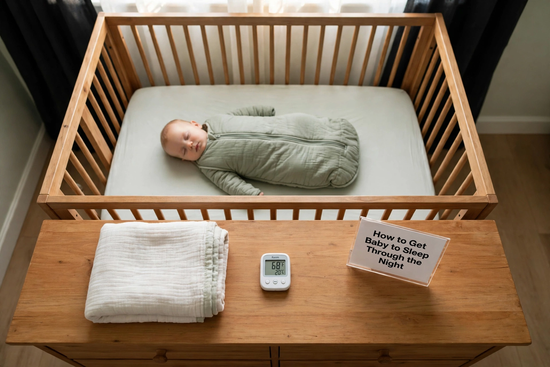
Place your baby on their back, alone, on a firm, flat surface with nothing else in the crib, for every nap and every night. No sleep goal justifies loosening these rules.
Sudden unexpected infant death still claims about 3,400 American babies each year, according to a 2026 report in the CDC’s Morbidity and Mortality Weekly Report. That works out to roughly nine families every day, so the crib stays bare even when a rolled blanket seems to soothe.
Viral life hacks can make daytime easier, but skip ones such as rolled towels to prop a baby on their side, inclined loungers, or weighted sleep sacks. Stop swaddling at the first sign of rolling and switch to an arms-free sleep sack.
How Does Sleep Change Once Your Baby Becomes a Toddler?
Most children drop from two naps to one between 15 and 18 months, and bedtime stalling replaces night feeds as the main problem. Firm limits and an early bedtime solve most of it.
- Drop the second nap only after two weeks of refusals, and move bedtime 30 minutes earlier during the switch.
- Keep the crib until closer to age 3, since an early move to a bed often leads to night roaming.
- Use a toddler clock that changes color at wake time to stop 5 a.m. visits.
- Offer two choices inside the routine, such as which pajamas or which book, so your toddler feels in control without delaying bedtime.
Parents searching for how to stop toddler hitting when angry often find the hitting spikes on short-sleep days. Protect the nap and the early bedtime first, then work on calm, consistent consequences.
Frequently Asked Questions
Is it okay to let my baby cry it out?
Brief, monitored crying is considered safe for healthy babies older than 6 months, though gentler methods reach the same result more slowly. Choose one approach and stick with it for at least two weeks, because switching methods confuses babies.
What is the 4-month sleep regression?
The 4-month sleep regression is a permanent shift to adult-style sleep cycles that makes babies wake more between cycles. The rough patch usually eases in two to six weeks, especially when you start putting your baby down drowsy but awake.
Should I wake my baby to feed at night?
Wake a newborn for night feeds only if your pediatrician asks, which typically lasts until birth weight comes back. After that, a healthy baby who is gaining well can set their own night schedule.
How long does it take to get a baby sleeping through the night?
Most families see longer stretches within one to two weeks of consistent changes. Illness, travel, and time changes set progress back a few days, so restart the routine as soon as life settles.
Does starting solids help a baby sleep longer?
Starting solids rarely lengthens night sleep by itself. Begin solids around 6 months for nutrition, and keep daytime milk feeds full, because that is what moves calories away from the night.
Conclusion
Learning how to get baby to sleep through the night depends on timing, routine, and patience, not tricks. Set the wake time, protect an early bedtime, keep the crib bare, and give your baby space to practice settling. Longer stretches come with age, and steady habits bring them sooner.